Olivia Blanch

Olivia BlanchOlivia BlanchOlivia Blanch
  • Home
  • About Me
  • Lobbying Congress
  • Poetry (and Other Beasts)
  • My Volleyball Crew!
  • 5 Things My Dog Taught Me
  • More
    • Home
    • About Me
    • Lobbying Congress
    • Poetry (and Other Beasts)
    • My Volleyball Crew!
    • 5 Things My Dog Taught Me

Olivia Blanch

Olivia BlanchOlivia BlanchOlivia Blanch
  • Home
  • About Me
  • Lobbying Congress
  • Poetry (and Other Beasts)
  • My Volleyball Crew!
  • 5 Things My Dog Taught Me

Lobbying for Change for the T1D Community

Congressional Hearing Day


I’m 17, and I’ve lived the past 4 years of my life with type 1 diabetes. But up until a few weeks ago, I’d never said those words—*“I have type 1 diabetes”—*in front of a crowd, let alone in front of a congressman.


I used to freeze up even thinking about speaking publicly. My voice would catch, my palms would sweat, and the words I practiced would vanish the second I needed them. But something changed this year. I started learning more about the Special Diabetes Program—the $160 million that goes to the NIH every year to fund the exact kind of research that’s kept me healthy and on track. The same program that expires next year if Congress doesn’t act. Suddenly, the idea of staying quiet felt more terrifying than speaking up.


So I wrote everything I wanted to say on a notecard. I practiced in front of my mirror, in front of my dog, then my mom, then my entire biology class. I signed up to be a Breakthrough T1D Advocate, and when they said there was an opportunity to meet with our local representative, I raised my hand before my fear could stop me.


The meeting was in a small, windowless office in D.C. The congressman was polite, distracted at first, and clearly used to people asking for things. But when I told him that I was diagnosed 4 years ago and that my insulin pump and CGM were products of the very research the SDP helps fund, he looked up. I told him about the artificial pancreas trials, the advances in eye disease treatment, how this research had made it possible for me to live like a normal kid, to dream about college, to dance at prom without checking my blood sugar every hour.


And then I looked him in the eye and said, “This program isn’t just about science. It’s about giving kids like me a future. And if we let it expire, that future shrinks.”


I walked out shaking but proud. I had done it. I had found my voice—not just for myself, but for the millions of others living with T1D. And I’ll keep using it. 


Because this matters. 


Because the road to a cure depends on us showing up and being heard.


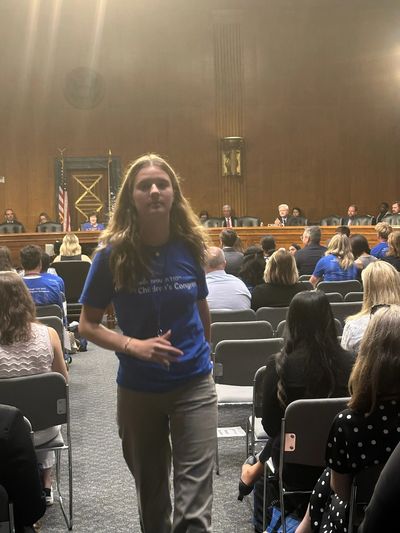
Stand and Deliver: Making My Argument on Capitol Hill.  You can too :)

Stand and Deliver: Making My Argument on Capitol Hill.  You can too :)

Public Speaking on capitol hill

Why a Bunch of Kids (and I) Showed Up on Capitol Hill for T1Diabetes — and Why You Should Care
In July 2025, Breakthrough T1D (that’s JDRF’s new name) brought 170 kid and teen delegates from all 50 states to Washington, D.C. to ask Congress for two BIG things:

  1. Renew the Special Diabetes Program (SDP) a federal research program that’s powered many of the biggest advances in Type 1 diabetes.  
  2. Make insulin and T1D care affordable so people can actually benefit from those advances. It worked: Senators introduced a bipartisan bill to renew SDP, and Congress put a short‑term extension in place so funding didn’t lapse on September 30, 2025. The longer, multi‑year renewal is moving forward. Here’s the full story, in plain English.  

What actually happened in D.C.

Picture this: 170 of us (kids and teens in blue shirts) swarming the Capitol with parent chaperones, insulin pumps and CGMs buzzing, and folders full of personal stories. It was Children’s Congress; Breakthrough T1D’s big, every‑other‑year advocacy event (July 7–9, 2025).

  • We had a Senate hearing called “A Future Without Type 1 Diabetes.” Senators from both parties showed up (yes, actually in the same room, agreeing on things).  
  • Senators Susan Collins and Jeanne Shaheen introduced a bill to renew the Special Diabetes Program.  
  • Then we fanned out across the Hill for hundreds of meetings with Senators and Representatives. We told them what T1D really feels like at 2:00 a.m., at soccer practice, in chem class, and on road trips when your pump site fails.  
  • There was even a surprise moment: Mattel unveiled a Type 1 Diabetes Barbie — CGM, pump and all. Cute, yes. But more importantly: visible. It says, “We exist. See us.”  


The Big Ask #1:

Renew the Special Diabetes Program (SDP)

 What it is: Since 1997, the SDP has sent dedicated federal dollars into Type 1 diabetes research at the NIH. If you’ve heard of CGMs, smarter pumps, artificial‑pancreas systems, screening for risk, or Tzield (the first drug that can delay the onset of T1D) — SDP helped make that possible.What we asked for: Don’t let it expire. Keep funding steady (the current target is $160 million per year) so long‑running clinical trials don’t get cut mid‑stream. That’s how we get to real cell therapies and, eventually, cures.


What happened: 

  • A bipartisan bill to reauthorize SDP was introduced during Children’s Congress.  
  • As the Sept 30 deadline approached, Congress passed a short‑term extension so funding didn’t lapse. The multi‑year renewal is now moving through the process.  

Why it matters: Research can’t sprint if Congress keeps moving the finish line. Multi‑year funding lets scientists plan bold trials instead of living grant‑to‑grant.  


The Big Ask #2: Make insulin and T1D care affordable

There’s no point inventing life‑changing tech if people can’t afford the basics. Alongside research, we pressed for insulin affordability and policies that lower out‑of‑pocket costs for supplies (sensors, pumps, infusion sets). Think caps, transparency, and fixing the weird rebate loopholes that jack up prices. Why it matters: No one should ration the hormone that literally keeps them alive — especially not in the same country funding the research that proves what’s possible.  


Did it work?


Short answer: Yes — and it’s still working. 


  • Immediate win: No funding cliff. The SDP got a stopgap extension past Sept 30, 2025, so labs didn’t have to freeze trials or lay off staff.  


  • Momentum: The multi‑year SDP reauthorization has bipartisan backing and is moving forward.  


  • Insulin: Congress is actively debating affordability bills. Meanwhile, public pressure (including from this advocacy) has already pushed manufacturers toward lower list prices and caps in some plans — but we need consistent protections for everyone.  


Policy isn’t a movie with a single satisfying ending. It’s more like a series: cliffhangers, mid‑season wins, and a lot of “previously on…” The point is, we changed the plot. 


If you’re new to all this, here’s the jargon‑to‑human translator


  • Breakthrough T1D (fka JDRF): The largest nonprofit focused on T1D research, advocacy, and community. New name, same mission: “improve lives today and cure T1D tomorrow.” 
  • T1D (Type 1 diabetes): An autoimmune disease where your immune system destroys insulin‑making cells. You don’t outgrow it. You must take insulin.  
  • SDP (Special Diabetes Program): Dedicated federal funding that accelerates T1D research. Think of it as the engine under the hood.  
  • Cell therapies: Approaches to replace or protect insulin‑producing cells so your body can manage glucose again — essentially a path toward functional cures.  
  • Affordability policy: Laws that cap costs, clamp down on games that inflate prices, and make sure insurance actually…insures.  

Why this should matter to you (even if you don’t have T1D)


Because science plus policy is how we win. Research turns donations into discoveries. Policy turns discoveries into real‑life care you can access. One without the other is a half‑built bridge.Also: the kids you saw in those blue shirts? We’re not props. We’re future doctors, artists, engineers, teachers — people who will build the world you’ll live in. Give us working pancreases (or the next best thing), and watch what happens.  


How to help in 10 minutes:


  1. Call or email your members of Congress. Say you support a multi‑year reauthorization of the Special Diabetes Program and insulin affordability measures. (You can find your reps on the official House and Senate sites.)  
  2. Share a story. If you live with T1D or love someone who does, tell it. Stories move votes more than statistics.  
  3. Support Breakthrough T1D. Volunteer, donate, or just amplify the advocacy alerts.  
  4. Be loud, kindly. Bipartisan progress still needs public backup. A nudge from you keeps this on the front burner.  


One last thing . . .


People like to say “kids are our future.” Cute. But the truth is, we’re here now — writing testimony between AP Lit essays, swapping infusion sets between classes, and showing up in rooms where decisions get made. July 2025 proved something simple and powerful: When we tell our stories, Congress listens. When Congress listens, research moves.  When research moves, lives change. Let’s keep it moving!
  • Olivia Blanch's Blog
  • Poetry (and Other Beasts)
  • My Volleyball Crew!

Olivia Blanch

Copyright © 2025 Olivia Blanch - All rights reserved

Powered by Olivia